The Industrial Diamond Dilemma: Balancing Natural Scarcity and Synthetic Expansion
The world of industrial diamonds is as captivating as it is complicated, full of tricky parts and tangled issues that often get overlooked. Beyond their glamorous reputation as gems, natural industrial diamonds serve critical roles in cutting, drilling, grinding, and polishing in modern manufacturing and construction. In this editorial, we dive in to closely examine how five dominant countries control 99% of natural industrial diamond mines, while synthetic diamond technology steadily reshapes the market landscape.
While many associate diamonds with luxury jewelry, the industrial segment is a completely different ball game—one that demands precision, consistency, and reliability. It is a sector where natural stones, mostly acquired as a byproduct of gem mining, share space with lab-grown diamonds that cater specifically to the needs of industrial abrasives. These development trends not only trigger interesting economic debates but also offer fertile ground for opinions on supply chain security and globalization.
Understanding Industrial Diamonds: Natural Versus Synthetic
At first glance, the term “industrial diamond” might conjure images of exquisite stones, but nothing could be further from the truth. These diamonds are characterized by their toughness and ability to withstand heavy pressure, making them indispensable for a wide range of applications—from highway repair to delicate block polishing in microelectronics.
Natural industrial diamonds emerge as incidental findings from gem mining operations in locations known for hosting diamond-bearing pipes. In contrast, synthetic diamonds—engineered primarily through high pressure, high temperature (HPHT) or chemical vapor deposition (CVD)—are made to order with defined particle sizes, toughness, and coating options. This uniformity is critical for manufacturers who need their abrasive materials to perform consistently on job sites and assembly lines.
Some of the most intriguing aspects of industrial diamonds include:
- Consistency Matters: The subtle details of uniformity in synthetic diamonds enable manufacturers to minimize variability.
- Flexible Applications: With controlled properties, lab-grown diamonds can be customized for applications ranging from cutting tools to semiconductor wafers.
- Economic Safety: Synthetic diamond production sidesteps many of the intimidating political and geological risks linked with natural diamond mining.
Industrial Diamond Mining: A Tight Global Hold
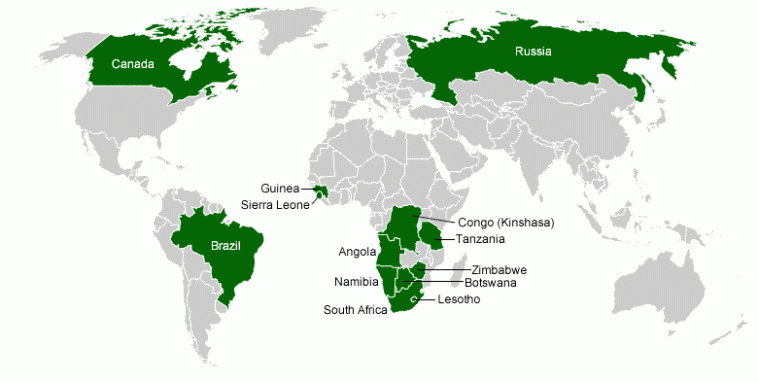
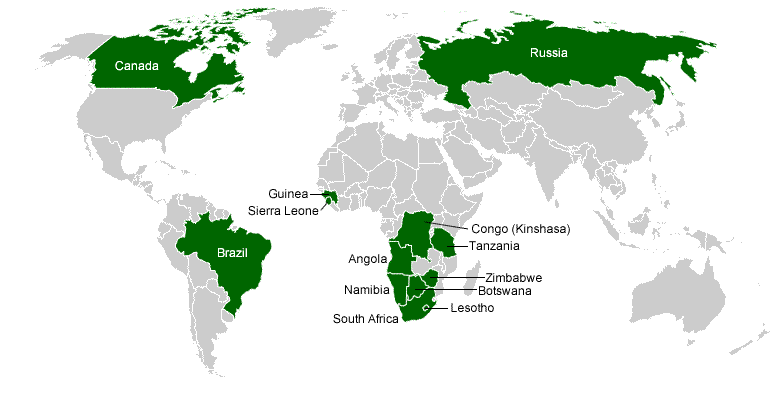
In the natural industrial diamond market, five countries—Russia, Botswana, Congo (Kinshasa), Zimbabwe, and South Africa—collectively control almost 99% of global output. For example, in 2024 Russia generated approximately 16 million carats, with Botswana at 8 million and Congo, Zimbabwe, and South Africa each making significant contributions to the supply. This concentration is largely due to the limited number of commercial kimberlite and lamproite operations across the globe, making geographical distribution a critical factor in this niche market.
Although natural industrial diamonds are a byproduct of gem mining, their supply chain is influenced by both natural limits and geopolitical tensions. Many of the mines are set in regions where ore bodies are either remote, small in scale, or simply nearing depletion. As these older mines reach the end of their productive lives, the overall output tends to plateau before eventually declining—a trend that has far-reaching implications for the global market.
The reality is that once a high-quality deposit is exhausted, mining companies are forced to face the daunting task of either pushing forward into more remote areas or stepping away altogether. The limited nature of these natural resources adds to the overall tension in global supply, driving many industrial users to cast a wary eye toward synthetic diamonds as a safer, more scalable alternative.
Geopolitical Influences and Economic Impact on Diamond Mining
The global landscape of natural industrial diamond mining is riddled with political and economic tension that shapes both local and international markets. The dominance of a handful of countries in diamond production gives rise to challenges that researchers and political analysts closely watch. With such a high concentration, regional political instability or trade restrictions can ripple out to affect international supply chains.
Several key factors come into play when examining the economic influence of diamond mining:
- Local Economies: Regions hosting diamond mines often rely heavily on mining operations. The byproduct flows from gem mining contribute significantly to local economies, supporting basic infrastructure, community services, and job creation.
- Global Supply Security: When most industrial diamonds come from just a few countries, any disruption—be it political, environmental, or economic—can have overwhelming effects on global supply.
- Policy and Regulation: International trade policies and local mining regulations further complicate the picture, as governments balance economic development with sustainable practices.
Given this close interweaving of local and global interests, one can see why many industrial users and policymakers are increasingly advocating for expanded synthetic diamond production. Not only can these lab-grown alternatives be produced in controlled environments, but they also offer manufacturers the ability to steer through complicated supply chain issues without being at the mercy of external political forces.
Industrial Diamond Production: Economic Benefits and Trade-offs
The economic arguments in favor of synthetic diamond production are many. From a supply perspective, scaling lab-grown diamonds is simply more efficient than exploring and developing new natural mines—a process mired with nerve-racking delays and off-putting regulatory hurdles.
Some of the economic benefits include:
- Scalability: Synthetic diamond production methods allow manufacturers to ramp up production orders quickly in response to market demand. This flexibility is crucial in industries like automotive manufacturing and microelectronics, where operational delays can be costly.
- Predictable Quality: Controlled production environments ensure that each batch of diamonds meets strict quality standards, reducing the risk of variability that can lead to production inefficiencies.
- Lower Production Risks: Unlike natural mining, synthetic production avoids the confusing bits of geopolitical risks and remote logistics that can drag down output from mine-dependent regions.
While these benefits make a compelling case, there are still concerns among purists and long-time industrial users who believe that natural diamonds bring unique properties that are difficult to replicate. It’s important to note that both types have their place within the industry; the choice often depends on the specific needs and cost targets of the project at hand.
The Future Outlook: Synthetic Diamonds and Shifting Market Dynamics
Looking forward, the future of industrial diamond production is full of both promise and challenges. As technological advancements continue to streamline and improve synthetic diamond production, the global balance between natural and lab-grown stones is likely to shift further in favor of the latter. High pressure, high temperature processes and chemical vapor deposition have come a long way in replicating the fine points of natural diamonds, making them a key component in modern industrial applications.
For instance, the semiconductor industry relies heavily on diamond grit for tasks such as lapping and polishing wafers. Here, the consistent quality of synthetic diamonds has become paramount, especially considering that even slight differences in edge sharpness or heat dissipation can result in production errors and increased waste. This attention to detail underlines how essential it is for industrial buyers to have a dependable supply of materials that can be customized to their exact requirements.
Moreover, as energy costs and environmental pressures mount, synthetic diamond manufacturers are beginning to prioritize energy efficiency and sustainability in their processes. By reducing the carbon footprint associated with production, these companies not only secure a competitive edge but also address broader societal concerns.
In summary, the future of industrial diamond technology may well be defined by factors such as:
- Technological Innovation: The continual improvement in synthesis techniques will drive down costs and improve quality, making synthetic diamonds an even more attractive option.
- Sustainability Initiatives: Energy-efficient production and greener practices in industrial manufacturing will likely be a must-have demand from environmentally conscious buyers.
- Market Responsiveness: With synthetic production, the industry can quickly figure a path to scaling up output in response to sudden surges in demand, particularly in sectors like automotive and electronics.
Comparative Analysis: Natural Versus Synthetic Diamond Advantages
It is helpful to break down the unique benefits and limitations of both natural and synthetic industrial diamonds to better understand how each serves its respective role in modern industry. Below is a table outlining the key factors:
| Feature | Natural Industrial Diamonds | Synthetic Diamonds |
|---|---|---|
| Origin | Byproducts of gem mining; largely formed by geological processes | Engineered under controlled high-pressure and high-temperature conditions |
| Supply Consistency | Subject to mining lifecycle issues and geopolitical risks | Highly uniform and scalable, offering consistent product quality |
| Customization | Limited; properties depend on natural formation and recovery methods | Highly customizable in terms of size, toughness, and coating |
| Market Influence | Dominated by a few key countries with mature, yet depleting mines | Quickly expanding, with applications across a broad spectrum of industries |
| Economic Security | Subject to supply disruptions and local political tensions | Offers a buffer against external political and economic instability |
This comparative review shows that while natural diamonds have historically played a crucial role in many industrial applications, synthetic diamonds are increasingly filling the gaps left by declining output and inconsistent supply routes. Each option carries its own set of advantages and trade-offs, and the ultimate choice rests on a company’s specific operational requirements and long-term strategic goals.
Industrial Applications: How Diamonds Shape Modern Manufacturing
The practical applications of industrial diamonds extend across several key sectors, many of which have a direct impact on everyday life and national economies. Whether it’s the construction of highways, the precision needed in semiconductor manufacturing, or the high standards required by automotive suppliers, industrial diamonds have firmly cemented themselves as a must-have resource across multiple domains.
Some of the major areas of application include:
- Construction and Infrastructure: Diamond grinding restores pavement smoothness and helps achieve the perfect finish on concrete surfaces. This application reduces tire noise and improves overall friction on roads, ensuring safer travel conditions.
- Electronics and Semiconductor Manufacturing: Chipmakers rely on diamond grit to lap and polish silicon wafers. The uniformity of the synthetic diamonds helps to maintain critical fine shades of precision needed in microchip production.
- Automotive and Railway Industries: In these sectors, diamond tools finish wear-resistant parts and help achieve tight tolerances required for safe and efficient operation. This ensures that mechanical components maintain their integrity over long-term usage.
- Oil, Gas, and Geothermal Drilling: Diamond-impregnated drill bits are essential for penetrating tough formations. Their robust properties help companies figure a path through rocky terrain and minimize downtime during heavy drilling operations.
- Bridge and Pavement Rehabilitation: Diamond saw blades and polishing tools are critical for refurbishing existing infrastructure, a process that not only extends the lifespan of bridges and highways but also enhances overall safety.
Industrial users are less concerned with whether the diamond is natural or synthetic; they care about minute details like parts per million defects and predictable wear characteristics down to the nitty-gritty. This focus on performance is driving an increasing shift toward synthetic diamonds, which offer a level of consistency that natural stones often cannot guarantee.
Domestic Perspectives: The U.S. Industrial Diamond Market in Focus
Turning our attention to the United States, the picture of industrial diamond usage is both intriguing and instructive. In 2024, primary production of manufactured diamond bort, grit, and powder reached about 160 million carats in the nation, with an estimated value of 53 million dollars. Despite this, the U.S. did not produce any industrial diamond stones domestically, relying instead on a handful of companies scattered across Florida, Ohio, and Pennsylvania for primary production. This situation highlights a broader trend—while natural diamond mining remains largely dominated by foreign countries, the domestic market is rapidly expanding its capacity to produce synthetic diamonds.
Key factors that shape the U.S. market include:
- Import Reliance: With a 12 percent decrease in imports of natural and synthetic industrial diamonds from 2023 to 2024, the focus has shifted toward self-sufficiency. Companies are increasingly investing in technology to create diamonds in a lab setting, helping to buffer against global supply interruptions.
- Transportation and Logistics: The streamlined supply chains for synthetic diamonds facilitate rapid delivery and customization, which are super important attributes in industries with tight production timelines.
- Regulatory Environment: Domestic production benefits from a well-established regulatory framework that minimizes the nerve-racking twists and turns associated with mining in politically unstable regions.
Consequently, the U.S. is emerging as a leading market for synthetic industrial diamonds, driven by factors such as technological innovation, energy cost management, and the undeniable value of predictable performance delivered by synthetic materials. This shift supports a broader national strategy of reducing exposure to imported supply risks and forging a path toward a more self-reliant industrial base.
Environmental and Sustainability Considerations in Diamond Production
Environmental concerns and sustainability are becoming increasingly critical talking points in industrial manufacturing sectors across the globe. Traditional mining operations, including those for natural industrial diamonds, are typically associated with significant ecological disruption due to the large-scale removal of earth and the intricate waste management challenges that follow.
On the flip side, synthetic diamond production—though not entirely without environmental impact—offers avenues for improved energy efficiency and smaller ecological footprints. As manufacturers and regulators strive to find your way through complicated pieces of environmental compliance, key initiatives have emerged to mitigate the negative impacts of diamond production:
- Resource Optimization: Synthetic processes allow firms to better control energy input and reduce waste during production. This is particularly critical in industries where environmental regulations are getting stricter.
- Sustainable Sourcing: With natural diamond reserves coming from a limited number of countries, there is a growing emphasis on ensuring that mining practices are responsible and support local environmental restoration projects.
- Energy-Efficient Production: Innovations in high pressure and chemical vapor deposition methods are leading to production techniques that are less energy-intensive and therefore more sustainable over the long term.
For industrial users, sustainability is not just a buzzword—it is a must-have criterion for maintaining long-term operational viability. With governments around the world tightening environmental policies, companies are increasingly likely to pivot toward synthetic diamond manufacturing as a pragmatic solution that reconciles performance needs with sustainability goals.
Market Dynamics: Supply, Demand, and Emerging Trends
The evolution of the industrial diamond market continues to be characterized by both macroeconomic shifts and the fine points of technological innovation. As natural mines gradually dwindle due to resource depletion and geopolitical pressures, the market is increasingly loaded with problems that are rapidly being addressed through synthetic diamond production.
Some emerging trends in the market include:
- Demand Surge in High-Tech Industries: The growing need for high-quality abrasives in electronics and semiconductor manufacturing has prompted a surge in demand for customizable synthetic diamonds.
- Responsive Production Models: Unlike natural mining, which faces off-putting challenges in scaling up quickly, synthetic production facilities can rapidly adjust output based on market requirements.
- Competitive Pricing Pressures: With synthetic diamonds becoming more common, pricing dynamics are shifting. Manufacturers, in order to stay competitive, are striving to offer both quality and affordability to industrial buyers.
Manufacturers are increasingly looking to the following strategies to remain competitive in this evolving market:
- Streamlined Production Processes: Investing in the latest manufacturing techniques helps reduce wastage and improve yield, which in turn controls cost while maintaining high standards.
- Collaborative Industry Partnerships: By working together with research institutions and technology providers, companies can access new innovations that further drive product improvements.
- Risk Mitigation Strategies: Diversifying supply sources and investing in domestic production capabilities helps reduce exposure to the unpredictable twists and turns of global natural diamond mining.
Overall, the interplay between supply and demand in the industrial diamond arena provides a fascinating case study on how industries manage resource scarcity, technological disruption, and economic challenges all at once. With synthetic diamonds rapidly gaining traction, stakeholders from governments to private companies need to pay close attention not only to the immediate price signals but also to the broader implications for industry viability and environmental stewardship.
Challenges and Opportunities: Finding a Balanced Future
As we navigate the evolving industrial diamond landscape, companies and policymakers face many complicated pieces and intimidating challenges, but also promising opportunities. The reliance on natural diamonds—dominated by a few key countries—poses numerous risks, from supply shortages to geopolitical instability. Conversely, the advancements in synthetic diamond technology open up new avenues for innovation and enhanced performance.
Industry experts suggest that the following areas merit close attention in order to successfully manage the shift:
- Innovation in Synthesis Techniques: Continuous improvements in production methods will further narrow the fine shades of difference between synthetic and natural diamond characteristics.
- Investment in Recycling: The reclaiming of diamond material from worn-out drill bits and tools represents an important, yet often overlooked, opportunity for sustainable growth in industrial applications.
- Regulatory Reforms: Developing frameworks that promote both environmental sustainability and economic efficiency can help ease the nerve-racking regulatory challenges faced by mining operations.
- Enhanced Research and Development: By dedicating resources to understanding the subtle parts of industrial diamond performance, companies can ultimately deliver superior products tailored to exacting industrial standards.
This balanced approach is more than a market trend—it is a strategic imperative. For companies that depend on precision tools, it is essential to figure a path forward that combines the reliability of synthetic diamonds with the irreplaceable benefits sometimes found in natural stones. The overall goal is to create a market where supply is resilient, production is sustainable, and technological progress is continuously encouraged.
Concluding Thoughts: The Road Ahead for Industrial Diamonds
The current state of the industrial diamond market is a vivid illustration of how supply chains, technology, and geopolitics intersect in unexpected ways. With natural industrial diamond production increasingly concentrated in a handful of countries, the risk of supply disruptions remains a real and ongoing challenge. In contrast, synthetic diamond production, with its flexible, scalable, and consistent nature, is rapidly gaining momentum among industrial producers.
It is important for stakeholders—from manufacturing CEOs to government policymakers—to take a closer look at the trends shaping this industry. The delicate balance between resource scarcity and synthetic abundance will determine not only the future of industrial tools and abrasives but also influence broader economic and environmental policies. Whether for constructing durable highways, fabricating precise automobile parts, or crafting high-tech semiconductor devices, the impact of these diamond materials is far-reaching.
Ultimately, the path forward is clear: industries must work through the tangled issues of supply instability by embracing innovative synthetic solutions while responsibly managing the dwindling natural resources. With collaboration between the private sector, governments, and research institutions, we can make progress toward a safer, more sustainable, and economically secure future.
This editorial is intended to prompt discussions and stimulate thought about the balancing act required in managing both natural and synthetic industrial diamond supplies. As we continue to figure a path through the nerve-racking twists and turns of the global marketplace, one thing is unmistakable: the story of industrial diamonds is one of resilience, innovation, and the eternal quest for materials that make modern life possible.
Key Takeaways for Industrial Diamond Stakeholders
Before wrapping up, let’s summarize some critical points that can help industry watchers and decision-makers plan for the future:
- Be Aware of the Geopolitical Landscape: With 99% of natural industrial diamond production coming from five countries, political instability in these regions could directly impact supply.
- Invest in Synthetic Production: The scalable nature of synthetic diamond manufacturing offers a viable alternative that sidesteps many of the confusing bits associated with natural mining.
- Focus on Quality and Consistency: For industries that demand predictable performance—ranging from automotive to semiconductor manufacturing—the choice of diamond material can influence overall product quality.
- Plan for the Long Term: With natural mines nearing depletion, long-term strategies must balance current supply needs with the inevitable growth of synthetic diamond use.
- Sustainability is Key: Both environmental considerations and energy cost management will play a super important role in shaping the future of industrial diamond production.
By keeping these takeaways in mind, businesses and governments alike can better figure a path through the challenges and opportunities that lie ahead in the industrial diamond market.
A Final Word on the Evolving Landscape of Industrial Diamonds
The evolution of industrial diamond production is a story of two distinct yet converging worlds: the limited, geographically concentrated realm of natural diamonds and the rapidly expanding, technologically driven sphere of synthetic alternatives. This duality is reshaping the way industries think about supply security, production reliability, and environmental responsibility.
For professionals across the industrial spectrum—whether in automotive manufacturing, construction, or high-tech semiconductor production—the choice between natural and synthetic diamonds is no longer simply about tradition or cost. Instead, it has become a strategic decision built on the fine details of performance, predictability, and sustainability.
In navigating these changes, the industry must not only figure a path through the immediate challenges but also remain flexible enough to embrace future innovations that can redefine what is possible. As we move forward, it will be essential to balance the strengths of both natural and synthetic diamonds to secure a stable, productive, and sustainable industrial future.
In conclusion, while the twists and turns of industrial diamond production may seem intimidating, ongoing advancements in synthetic diamond technology promise to provide the reliability and efficiency necessary for modern manufacturing. With natural resources limited and geopolitical pressures ever-present, our collective focus must be on creating resilient supply chains that meet the high standards demanded by today’s industrial processes.
The story is still unfolding, and as stakeholders continue to figure a path through the complicated pieces of this dynamic market, one thing is clear: the role of industrial diamonds—both natural and synthetic—will remain a key driver of innovation and economic growth in the years to come.
Originally Post From https://www.earth.com/news/these-five-countries-account-for-99-percent-of-earths-natural-industrial-diamond-mines/
Read more about this topic at
Country Monopoly : r/victoria3
Monopoly Board to Country – Click Quiz #1